What changed
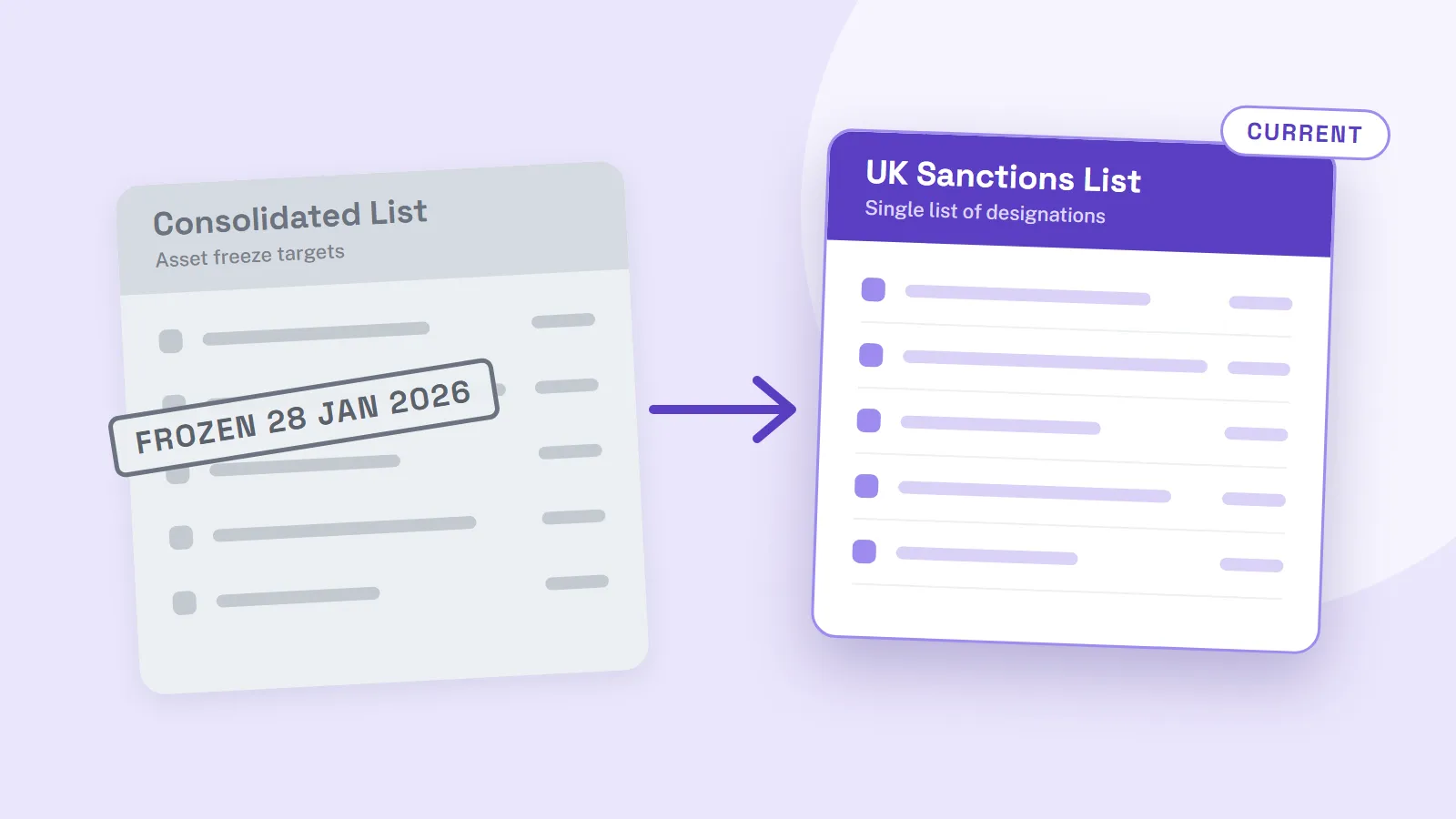
For years, accountants screening against UK financial sanctions used the Consolidated List of Asset Freeze Targets, which the Office of Financial Sanctions Implementation (OFSI) published for HM Treasury. On 28 January 2026 the UK Sanctions List, published by the Foreign, Commonwealth and Development Office, became the single source of UK sanctions designations, and the Consolidated List stopped being updated.
The UK Sanctions List isn’t new. It has existed alongside OFSI’s list for several years and covers designations made under the Sanctions and Anti-Money Laundering Act 2018. What changed is that it is now the only list kept current. The Consolidated List remains available for reference only.
The single list also includes designations that carry no financial measures, such as trade or immigration restrictions, so you may see more names than before.
Why it matters
Screening is only as good as the list behind it. A tool, script or spreadsheet that still downloads the old Consolidated List keeps working without an error, but it stops seeing anyone designated since January. Nothing looks wrong, which is what makes it easy to miss.
Five things to check
- The source your screening reads. Ask your provider, or check your own process, which list it downloads and when it was last updated.
- How often the list is refreshed. Designations can be added or changed on any working day, so a monthly manual check leaves gaps.
- Whether existing clients are re-screened. A client cleared last year should be checked again when the list changes, not only at their next review.
- The format of identifiers. Older entries keep their OFSI Group ID; names added since 28 January 2026 have only a UK Unique ID. If you store list references against cleared matches, make sure your records can hold the new ones.
- Your policies and procedures. If your AML policy names the Consolidated List, update it, and record when you did.
Recording what you did
Your supervisor may ask whether you noticed the change and acted on it. A short note on file covers it: when you checked your screening source, what you found, what you changed, and whether existing clients were re-screened.
A note you can adapt
“On [date] we confirmed that our sanctions screening reads the UK Sanctions List, which replaced OFSI’s Consolidated List on 28 January 2026. [If you did:] All approved clients and their beneficial owners were re-screened on [date]. Our AML policy was updated on [date].”
In FirmTier
FirmTier screens clients and their beneficial owners against the UK Sanctions List and the UN, EU and US OFAC lists. The lists are refreshed daily, and approved clients are re-screened overnight when a list changes. Each possible match is decided by a person at your firm, with the reason kept on the case, and decisions on past matches carry forward.
See how AML compliance works in FirmTier.
Sources
- Moving to a single list for UK sanctions designations, 28 January 2026 (GOV.UK)
- The UK Sanctions List (GOV.UK)
- Format guide for the UK Sanctions List (GOV.UK)
This article is general information, not legal advice. Check the current guidance from your supervisor, OFSI and the FCDO.